
Roof Leak Detection in Historic Sixth Street, Texas City, TX
The stain on your ceiling is almost never directly below the leak. Roof Leak Repair Pros is the local roof leak repair team for roof leak detection in Historic Sixth Street, Texas City, TX. The flat and low-slope sections on the historic commercial buildings are especially leak-prone after Gulf storms.
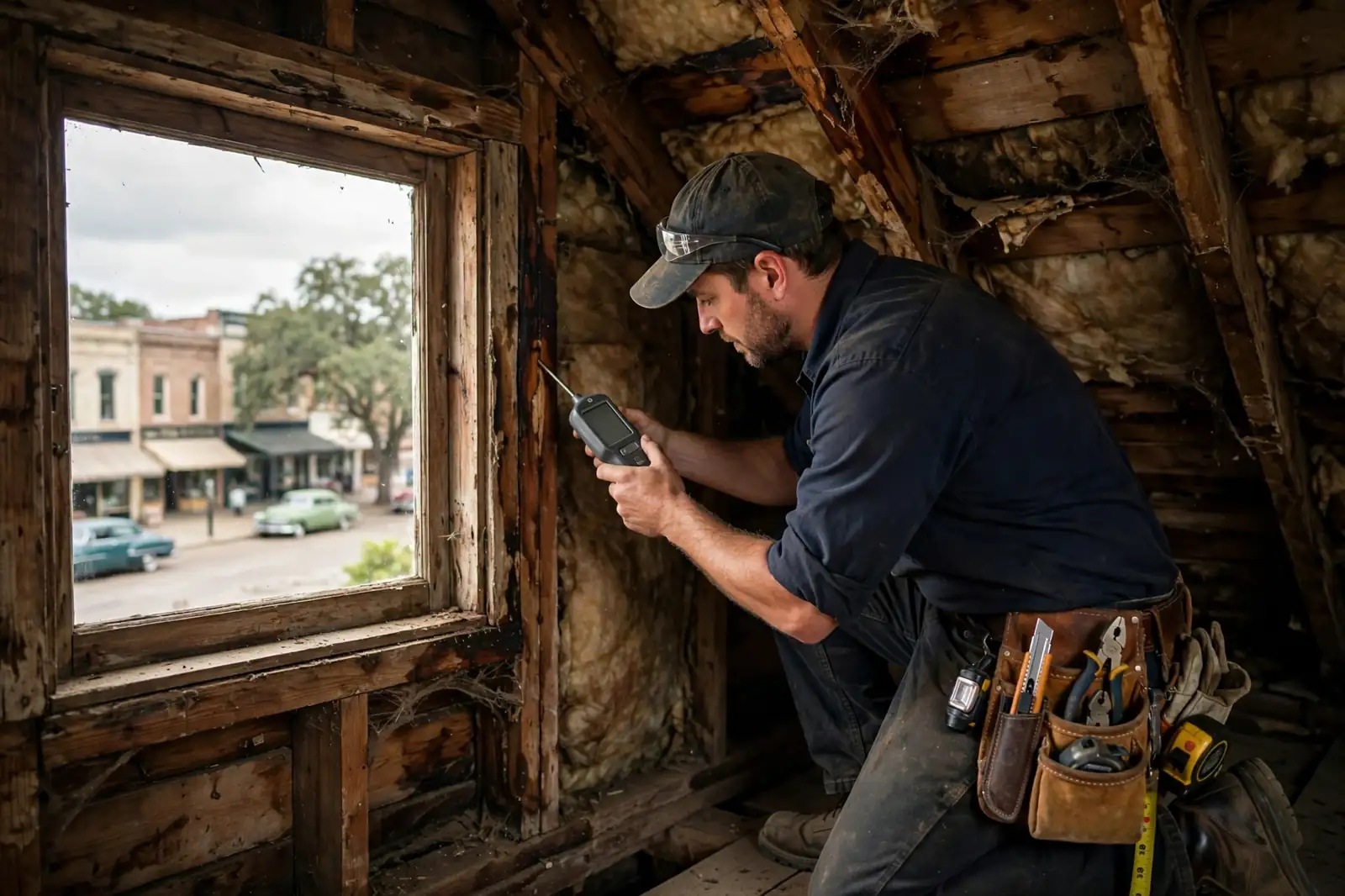
Roof leak detection is diagnostic work: finding the exact entry point before any repair begins. We map interior evidence with moisture meters, inspect the roof detail by detail, and run controlled water tests when needed — so the repair targets the real source, not the stain. Historic Sixth Street is Texas City's historic downtown corridor, lined with early-1900s commercial buildings and bungalows.
The Historic Sixth Street Factors That Hide Leaks
Local conditions shape how leaks behave. Older structures here often have multiple roofing layers and decades of patched flashing details. Wind-driven rain pushes water uphill under shingles, and multi-layer or complex roofs give water more paths to travel before it shows inside.
In Historic Sixth Street we also see leaks masked by recent re-roofs where new shingles cover failing flashing underneath — the roof looks fine from the street while water works in at the details. The flat and low-slope sections on the historic commercial buildings are especially leak-prone after Gulf storms.
- Intermittent leaks in specific weather
- Multiple small entries, not one big hole
- Wind-driven rain entering uphill
- Water traveling far from the stain
Why Leak Detection Matters Before Any Repair in Historic Sixth Street
Guessing at the source is the most expensive mistake in roofing. We regularly meet Historic Sixth Street homeowners who paid for two or three wrong repairs before the real entry point was found. Historic Sixth Street is Texas City's historic downtown corridor, lined with early-1900s commercial buildings and bungalows. Detection costs a fraction of a misdirected repair.
Our diagnosis ends with a written report — photos, moisture readings, and a repair plan — so you know exactly what failed and what the fix will cost before committing.
- Prevents paying for wrong-guess repairs
- Written diagnosis with photos and readings
- Repair plan with upfront pricing
- Pinpoints the true entry point, not the stain
Signs Your Historic Sixth Street Home Needs Professional Leak Detection
Stains that grow after rain and fade between storms, musty attic odors, peeling paint near ceilings, and insulation that is damp or compressed all point to an active leak with a hidden source. The flat and low-slope sections on the historic commercial buildings are especially leak-prone after Gulf storms.
The trickiest sign is a previous repair that didn't hold — it usually means the real entry point was never found. That's a detection job, not another patch.
- Ceiling stains with no obvious roof damage
- Musty odors in attic or upper rooms
- Stains that grow after rain
- Peeling paint or bubbling drywall
Related Services
Helpful Roofing Guides
- How to Find a Roof Leak: A Homeowner's Step-by-Step Guide
- What to Do When Your Roof Is Leaking Right Now
How Roof Leak Detection Works Differently in Historic Sixth Street, TX 77590
Leak detection is detective work, and Historic Sixth Street homes give us plenty of clues. 1940s–60s bungalows on pier-and-beam, the oldest housing stock in Texas City, and second- or third-generation shingles over aging decking, with rusted galvanized flashing. Water travels along decking, rafters and vapor barriers before it drips, so the stain on your ceiling can sit ten feet from the actual breach. Our diagnostic visit starts inside — attic inspection with moisture meters, tracing the wet path uphill — then moves to the roof surface, where we check the usual suspects in order: penetrations, flashing transitions, valleys and field shingles. In Historic Sixth Street, salt air plus industrial fallout that eats through old flashing, which pushes water sideways under laps and flashing, so we test with controlled water when the visual trail goes cold.
Homeowners in Historic Sixth Street (77590) often call us after a handyman sealed the obvious spot and the leak came back. That is the classic sign the true source was never found. Second- or third-generation shingles over aging decking, with rusted galvanized flashing, and on that kind of roof the failure is usually at a detail — a cracked pipe boot, a rusted valley, step flashing that lost its seal — rather than in the field of the roof. We map every suspect, photograph it, and show you before quoting the repair. Detection costs are credited toward the repair when you proceed with us, so the diagnostic visit never feels wasted.
Detection visits in Historic Sixth Street take longer than the repair often does, and that is the point: salt air plus industrial fallout that eats through old flashing punishes guesswork. We serve 77590 from the 6th Street commercial corridor, and every diagnostic ends with photos, the traced water path explained in plain language, and a fixed-price repair option.
What to Expect During Your Historic Sixth Street Visit
What makes detection different in Historic Sixth Street is the downtown grid near the refinery corridor. Moisture here does not just come from above; salt air plus industrial fallout that eats through old flashing, and humidity alone can mimic a leak in a poorly ventilated attic. Part of our diagnostic is ruling things out — condensation on ductwork, bath-fan moisture dumped into the attic, AC condensate lines — before we open up the roof. That saves Historic Sixth Street homeowners from paying for roof repairs that were never needed. When it is a genuine roof breach, you get photos of the exact entry point and a fixed repair price, not a range.
What to expect when we visit your Historic Sixth Street home: we start inside, tracing the water path through the attic with moisture meters, because second- or third-generation shingles over aging decking, with rusted galvanized flashing and the stain rarely sits under the breach. Then we walk the roof — salt air plus industrial fallout that eats through old flashing, so we check windward slopes and flashing laps first. You get photos of everything we find, a fixed-price repair quote before any work starts, and a water test when we finish. Most Historic Sixth Street (77590) visits wrap the diagnosis and the repair plan into a single appointment, and our call representatives at (888) 974-0663 can usually schedule you within days.
Roof Leak Detection in Historic Sixth Street FAQs
How do you find a leak you cannot see from inside Historic Sixth Street homes?
With moisture meters, attic tracing, and controlled water testing. In Historic Sixth Street, second- or third-generation shingles over aging decking, with rusted galvanized flashing, so we work uphill from the interior stain until the meter spikes — that is the entry zone. We photograph everything and show you before any repair is quoted.
Is detection worth it for an older Historic Sixth Street roof?
Usually yes — unless the roof is clearly at end of life. Second- or third-generation shingles over aging decking, with rusted galvanized flashing. A proper diagnosis tells you whether a targeted repair buys real years or whether the money is better held for replacement. We will tell you honestly which it is.
How long does leak detection take in Historic Sixth Street?
Most Historic Sixth Street homes take one to two hours. Complex roofs or intermittent leaks can take longer, especially if we need to run controlled water tests. We quote the time upfront.
Will detection damage my roof?
No. Our inspection is non-destructive — visual examination, moisture meters, and controlled water application. We never lift shingles or open anything without your approval.
Why can't I just find the leak myself?
From the attic you can sometimes see daylight or stains, but the entry point is usually uphill and sideways from where water appears. Without moisture meters and knowledge of how water travels, DIY detection usually seals the wrong spot.